2026-11-01
Skip These and You'll Age Fast: The Top 3 Best-Value Treatments a Plastic Surgeon's Wife Never Misses
A plastic surgeon's wife shares her top three best-value treatments: titanium laser for glowing skin, thread lifting for lasting firmness, and Juvelook for facial volume. She also explains how they differ.
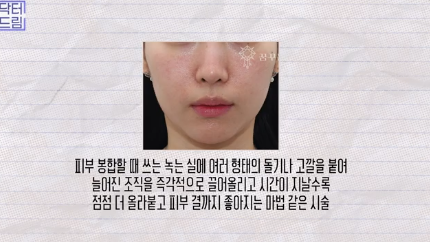

Hello!
I'm the wife of the head physician at Dreaming Plastic Surgery Clinic.

Today, under the title "A Plastic Surgeon's Wife's Favorite Treatments,"
I'd like to introduce the treatments I get most often and that have worked best for me.


Some patients who visit the clinic say they've seen the wife's video and ask what she's been up to these days.
My friends also ask me before they get any treatment,
asking me beforehand how painful it is, how well it works, and what it's good for.
People often ask me for a treatment that works well after just one session and lasts a long time. Unfortunately, I don't think such a thing exists.
It's like hair coloring: even after you dye your hair, you need to touch up your roots within three weeks.
Even if you pause or reverse aging for a while, it keeps progressing, so consistent maintenance is essential.

So at my age, it's no longer about looking prettier. It's about maintenance, because if you stop, you age noticeably fast.

The first is Titanium Lifting, which creates tanghulu-glass skin.
For maintenance, my number one favorite treatment is Titanium Lifting, which gives you tanghulu-glass skin.

If you're into aesthetic treatments, you've probably already heard of it.
Titanium is a light-based laser, so there's almost no pain,
and even though it doesn't hurt, you see results right away.
Starting that very day, the way lotion glides on after cleansing feels completely different. It's amazing.

It brightens and clears the skin and smooths out fine lines, so it feels like an all-in-one fix.
It emits three wavelengths, so it stimulates skin from the deepest layers to the surface all at once.

It has two modes: a quick sweeping movement, and a slow, firm pressing movement like stamping a seal.
By stimulating the entire face at multiple depths, it works even better.
In simple terms, I describe titanium as the treatment that creates tanghulu-glass skin.
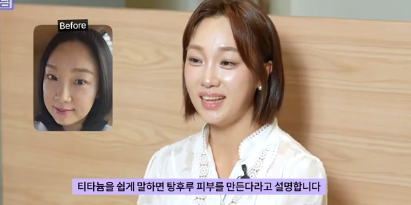
This laser booster leaves skin smooth and shiny, like tanghulu. I get it regularly, and I tell everyone around me that it's an absolute basic.

Titanium vs. Onda
If titanium is the one that makes skin glow and improves its texture,
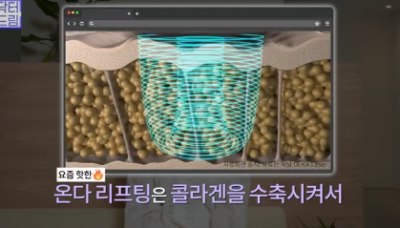

Onda Lifting, which is very popular these days, tightens collagen to firm and lift the face. It's designed for facial slimming.
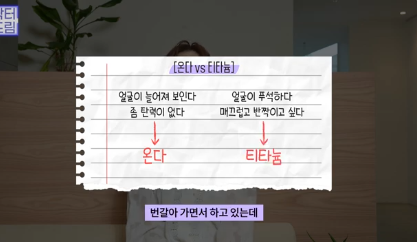
Face looks sagging or lacks firmness -> Onda. Face looks dull and you want it smooth and radiant -> Titanium
If your face looks sagging or a bit lacking in firmness, go for Onda.
If your skin looks dull and you want it smooth and glowing, Titanium is the choice. I alternate between the two.
Onda works on the same principle as a microwave oven, so it's painless, and I get it without any worry.
The second is thread lifting.

Thread lifting uses dissolvable sutures, the kind used to close the skin,
with various types of barbs or cones attached to lift sagging tissue immediately,
and over time, the tissue continues to firm up and lift further while skin texture improves. It's a magical-feeling treatment.
I get it every one to one and a half years.
Honestly, if I hadn't gotten threads, I'd probably be walking around with a sagging face by now. Haha.

At first I thought, "Threads in my face?"
I figured, "Wouldn't I be unable to make facial expressions with threads pulling on my face? Isn't that weird?"
I pictured the thick cotton thread used in a baby's first-birthday ritual and was horrified,
but it turned out to be medical-grade thread,
a safe suture that dissolves gradually inside the skin. I remember feeling relieved.

The main types include Mint Thread, which has barbs running 360 degrees like rose thorns to lift tissue in 3D,
and Silhouette Soft, which has collagen powder inside its dissolvable cones. As the cones melt away over a set period, the collagen is released,
giving a dual effect of firmer skin and a stronger lift. Silhouette Soft is a prime example.
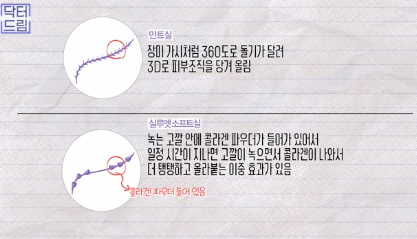
I use different threads depending on the area I'm concerned about at the time. Since I do thread lifting every one to one and a half years, I think its advantage is that you can tailor the type, number, and design of threads to the specific area you want to address in each situation.
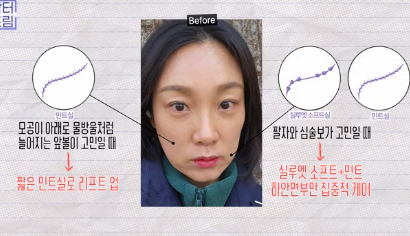
When my concern is the front cheeks, where pores sag downward like droplets, I go with short Mint Threads.
When the concern is nasolabial folds and marionette lines, I can combine Silhouette Soft and Mint Threads and focus only on the lower face,
so the treatment can be customized to the facial concerns that change every year. I really like that.
Thread lifting can be done under sedation or with local anesthesia.

I've tried both.
For a full-face treatment, I'd recommend sedation so you can relax.
If you only want to treat one or two specific areas quickly, local anesthesia alone is perfectly fine.
With local anesthesia, you feel a bit of pressure when the medication goes in, and during the procedure you only sense which area is being worked on.
It doesn't hurt, but it's a little scary and tense, so you tend to tighten up. I'd heard that tensing up can cause bruising,
so I tried my best to relax as much as possible.
It doesn't hurt, but as the thread pulls and lifts the tissue, there's a crunchy, tearing sound, like ripping open a sack of soft tissue,
which scared me at first, but after a few sessions I got used to it.
Thread lifting's biggest advantage is that it's the only lifting treatment that directly pulls up tissue,
and that your skin noticeably improves about a month later.

When threads are inserted, they cause minor wounds, and the body rapidly regenerates collagen to heal the tissue.
Lasers also aim for this kind of regeneration, but the amount of collagen produced
differs completely between lightly burning the skin with a laser
and physically tearing tissue to create a wound.

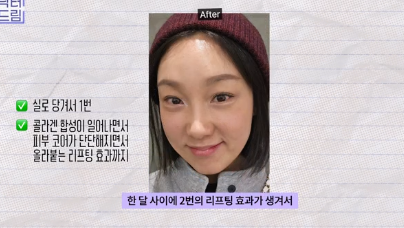
The threads pull once, and then as collagen synthesis kicks in and the skin's core structure firms up, you get a second lifting effect as well.
Within a month, you get two lifting effects. After one round of threads, I'm confident you'll think,
"Ah, so this is what real lifting is!"
Juvelook, recommended for anyone concerned about a hollowed-out face


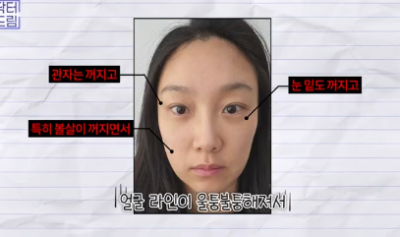

As we age, facial fat diminishes, so the temples hollow out and the under-eyes sink too,
and especially when cheek volume is lost, the facial contour becomes uneven. To create a round, smooth facial line,
Juvelook is a must.
Juvelook is a treatment in the same category as fillers. It fills in hollowed areas.

Fillers use hyaluronic acid that has been reconfigured to last longer,
giving instant volume that gradually fades over time.
Their advantage is that results are immediate, and there's an injection that can dissolve them if you're unhappy or something goes wrong,
but many people dislike fillers in general, so some hesitate.
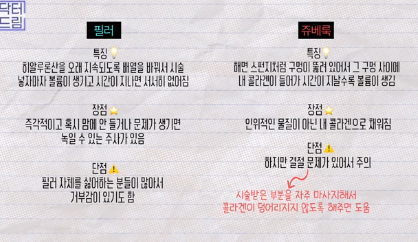
Juvelook has a porous structure, like a sponge, so your own collagen grows into the spaces between the pores
and volume builds up over time. Its advantage is that it's filled with your own collagen rather than an artificial substance.
However, because nodules can form, you need to be careful.
Massaging the treated area often to keep the collagen from clumping seems to help.
For Juvelook, it's said that three sessions about a month apart make the results last longer, though this varies from person to person.
So try it once, watch how it progresses, and consult with a specialist before getting additional sessions.
Beyond that, proper lifting treatments,

ultrasound treatments like Ulthera that lift the facial contour,
Tensema, which firms and tightens the skin,
and Rejuran, which improves skin texture and creates a dewy, hydrated glow,
They're all great treatments and helpful, so it was really hard to choose.
For Rejuran, since it can be painful, I have it done under sedation,
and I find that when 4cc is injected per session, the results are clearly and noticeably better.

So far, I've introduced the top three treatments a plastic surgeon's spouse loves most.

Results vary from person to person and depend on skin type and circumstances, so please treat this as a reference only,
and for an accurate diagnosis and treatment plan, please consult with the doctor pictured here.

#Aging #AntiAging #DermatologyTreatment #PlasticSurgeryTreatment #SkinCare #AgingCare #FirmnessCare #SkinFirmness #ThreadLifting #TitaniumLifting #TitaniumLaser #Onda #OndaLaser #Juvelook #JuvelookVolume #MintThread #SilhouetteThread #SilhouetteSoft #DeepCheekVolume #NasolabialFolds #DreamingPlasticSurgery #GangnamStationPlasticSurgery
Frequently Asked Questions
Does titanium lifting hurt?
According to the author, titanium lifting involves little to no pain. It uses a light-based laser, and results are visible right after the session. The author also says lotion spreads differently after cleansing starting that same day.
How is Onda lifting different from titanium lifting?
Onda lifting is described as a way to tighten the face, while titanium lifting is described as a way to enhance skin texture and radiance. The author suggests choosing Onda if the face looks sagging or lacks firmness, and titanium if the skin looks dull and you want it smooth and glowing.
What types of anesthesia are available for thread lifting?
The author explains that thread lifting can be done under either sedation or local anesthesia. For the full face, sedation is recommended for comfort, while local anesthesia alone is considered sufficient when only one or two areas are a concern. With local anesthesia, the author says you may feel a slight pressure when the medication is injected.
How does Juvelook add volume?
Juvelook is described as a treatment in the same category as fillers, used to fill in hollowed areas. Your own collagen grows into its sponge-like, porous structure, so volume builds up over time. Because nodules can form, caution is needed, and the author notes that massaging the treated area frequently can help prevent the collagen from clumping.
Do results last long after just one session?
The author says there doesn't seem to be a treatment that lasts long after a single session. Because aging keeps progressing, consistent maintenance is necessary. The author also shares that thread lifting is done every one to one and a half years.